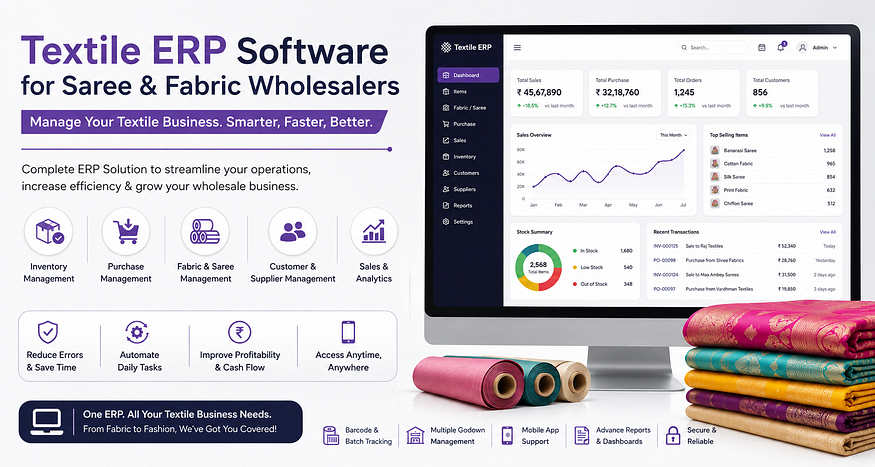
Running a saree or fabric wholesale business is nothing like running a regular retail shop. You’re dealing with thousands of variants different designs, colors, blouse pieces, fabric types, weaves, and lot numbers often across multiple godowns and cities. A single saree design might have 15 color variants, each with its own stock count, rate, and buyer preference. Add in bulk B2B orders, seasonal demand spikes during wedding and festival seasons, and payments that stretch across 30, 60, or 90 days credit cycles, and you quickly realize why generic billing software or Excel sheets stop working.
This is exactly where a Textile ERP built specifically for saree and fabric wholesalers becomes essential not a generic ERP adapted to fit textiles, but one designed around how this trade actually operates.
Why Saree & Fabric Wholesalers Need a Specialized ERP
Most ERP systems are built for manufacturing or general trading businesses. They handle SKUs, stock, and invoicing but they don’t understand design-color-size hierarchies, piece-meter based billing, or lot-wise stock tracking, which are core to the textile trade.
A saree wholesaler doesn’t just sell “one product” they sell a design that exists in 10–20 color variations, each variation tied to a specific lot, and each lot having its own cost price, incoming date, and quality grade. Trying to force this structure into a generic inventory system leads to constant errors: wrong color sent, wrong lot billed, stock showing available when it’s actually sold out.
A textile-focused ERP like Wortal.co is built to handle this complexity from day one so your billing, inventory, and order management actually reflect how your business really works, not how a generic template assumes it should.
Key Challenges Saree & Fabric Traders Face Without the Right System
1. Design and Color Variant Confusion Without proper variant-level tracking, it’s common to lose track of which colors are in stock, which are sold out, and which are on order. This leads to overselling and disappointed buyers.
2. Lot-Wise Stock Mismatch Fabric quality can vary between lots even for the same design. Selling from the wrong lot or not knowing which lot has how much stock causes quality complaints and returns.
3. WhatsApp Order Chaos A huge share of saree wholesale orders still come through WhatsApp images, voice notes, and text mixed together. Without a system to convert these into structured orders, mistakes multiply and follow-ups get missed.
4. Credit Cycle & Payment Tracking Wholesale textile trade runs heavily on credit. Manually tracking who owes what, for how long, and which invoices are overdue becomes unmanageable once you cross a certain order volume.
5. Multi-Location Godown Management Many traders operate from more than one godown or have goods lying with agents in other cities. Knowing exactly what’s available where, in real time, is nearly impossible without a centralized system.
Key Features to Look for in a Textile ERP
When evaluating a Textile ERP for your saree or fabric business, prioritize:
- Design-Color-Lot Hierarchy: The system should let you manage stock at the design level, drill down to color variants, and further to specific lots not just flat SKUs.
- Piece & Meter-Based Billing: Ability to bill in pieces, meters, or sets, since fabric and saree sales often mix units.
- WhatsApp Order Integration: Converting WhatsApp-based orders directly into the system reduces manual entry errors and speeds up processing.
- GST-Compliant Invoicing: Automatic GST calculation and invoice generation built for how textile trade actually bills HSN codes, tax slabs, and all.
- Credit & Payment Tracking: Real-time visibility into outstanding payments, credit limits per buyer, and ageing reports.
- Multi-Godown Inventory Sync: Live stock visibility across all locations so your sales team never quotes stock that isn’t actually available.
- Order-to-Dispatch Workflow: A clear pipeline from order received to picked, packed, and dispatched reducing the back-and-forth confusion common in manual processes.
- Return & Exchange Handling: Since returns are common in this trade due to color/quality mismatches, the system should make this process simple to track and reconcile.
How Wortal.co Solves This for Saree & Fabric Wholesalers
Wortal.co is built specifically with textile trade complexity in mind not adapted from a generic template. Here’s how it addresses the core pain points:
- Variant-First Inventory: Every design in Wortal.co can carry unlimited color and lot variants, with real-time stock visibility down to the lot level. No more guessing which color is actually available.
- WhatsApp to Order Conversion: Orders coming in through WhatsApp can be logged and converted into structured system orders quickly, cutting down on manual re-entry and miscommunication.
- Built-In GST Billing: Every invoice generated through Wortal.co is GST-compliant by default, saving time during both billing and filing.
- Credit Tracking Dashboard: Wortal.co gives you a clear view of which buyers owe what, for how long, helping you follow up on payments before they become a problem.
- Multi-Godown Support: If you operate across multiple cities or godowns, Wortal.co keeps stock synced in real time, so your team always quotes accurate availability.
- Simple Order Lifecycle: From order booking to dispatch, Wortal.co gives you a clean, trackable workflow so nothing falls through the cracks — even during your busiest wedding-season rush.
Who Should Consider a Textile ERP Like Wortal.co
- Saree wholesalers managing multiple designs with heavy color variation
- Fabric traders dealing in bulk meter-based sales
- Businesses receiving a large share of orders through WhatsApp
- Traders operating from more than one godown or city
- Growing businesses that have outgrown Excel or basic billing software but don’t need the complexity (or cost) of a full-scale manufacturing ERP
Final Thoughts
The saree and fabric wholesale trade has its own rhythm design-heavy catalogs, color-driven buying decisions, WhatsApp-first ordering, and long credit cycles. Trying to run this on Excel sheets or generic billing tools eventually leads to errors that cost you both money and buyer trust.
A Textile ERP built for this specific trade like Wortal.co bridges that gap. It doesn’t force your business into someone else’s template; it’s built around how saree and fabric wholesalers actually work, from lot-wise stock tracking to WhatsApp order conversion to GST-ready billing.
If you’re still relying on registers, Excel sheets, or basic invoicing software to run a growing wholesale business, it might be time to see what a purpose-built system can do for your day-to-day operations and for your bottom line.